
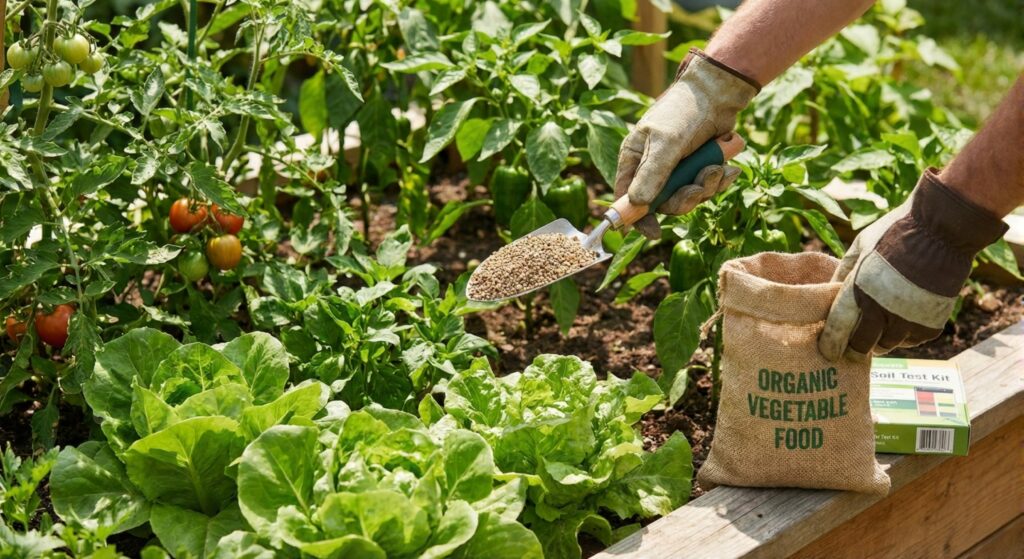
Introduction: Feeding Your Garden for Success
Have you ever looked at a neighbor’s vegetable garden, bursting with bright red tomatoes and peppers the size of softballs, and wondered, “What is their secret?” It’s not magic, and they aren’t whispering ancient spells to their zucchini. The secret usually lies right beneath the surface: Nutrient Management.
Think of your vegetable plants like growing teenagers. If you feed a teenager nothing but water and sunshine, they might survive, but they won’t thrive, and they certainly won’t win the football game. Your plants are the same. They need a balanced diet to produce that bumper crop you’ve been dreaming of. But walking down the fertilizer aisle at the garden center can be intimidating. There are numbers, chemicals, smelly bags of manure, and colorful bottles everywhere. Where do you even start?
Don’t panic. This guide is going to strip away the confusion. We are going to break down the science of vegetable fertilizers into simple, bite-sized pieces so you can feed your garden with confidence.
Understanding the Basics of Plant Nutrition
Before we start throwing granular pellets around, we need to understand what your plants are actually craving. Plants, much like humans, require essential minerals to function. While they get carbon, hydrogen, and oxygen from air and water, they rely on the soil for the rest.
What Are N-P-K Ratios?
Grab any bag of fertilizer, organic or synthetic, and look at the front. You will see three numbers separated by dashes, like 10-10-10 or 5-10-5. This is the N-P-K ratio. It stands for Nitrogen, Phosphorus, and Potassium. These are the “macronutrients”—the meat and potatoes of the plant world.
Nitrogen (N): The Green Machine
The first number is Nitrogen. Think of Nitrogen as the gas pedal for leafy growth. It is responsible for making plants look lush, green, and vibrant. If you are growing lettuce, spinach, or kale, Nitrogen is your best friend. However, too much of a good thing can be bad. If you give a tomato plant too much nitrogen, you’ll get a massive, beautiful green bush, but zero tomatoes. The plant gets so busy making leaves it forgets to make fruit!
Phosphorus (P): The Root and Bloom Builder
The middle number is Phosphorus. If Nitrogen is the leaves, Phosphorus is the “under the hood” mechanic. It focuses on strong root development and, crucially for vegetable gardeners, flower and fruit production. When you want juicy tomatoes, crisp peppers, or big pumpkins, you want to make sure your Phosphorus levels are adequate.
Potassium (K): The Overall Health Booster
The final number is Potassium (often called Potash). Think of this as the plant’s immune system and circulation. It helps the plant move water and nutrients around, fight off diseases, and withstand stress like heat or cold. It’s the multivitamin that keeps the whole system running smoothly.
Don’t Forget the Micronutrients
While N-P-K gets all the glory, plants also need micronutrients. These are like the trace minerals in our diet—calcium, magnesium, sulfur, iron, and zinc. For example, a lack of calcium often causes Blossom End Rot in tomatoes, where the bottom of the fruit turns black and mushy. A good fertilizer plan considers these unsung heroes, too.
Organic vs. Synthetic Fertilizers: Which is Better?
This is the great debate of the gardening world. Is one better than the other? The honest answer is that your plant doesn’t know the difference; it absorbs nutrients as ions regardless of the source. However, the soil knows the difference.
The Case for Organic Fertilizers
Organic fertilizers (compost, manure, bone meal, fish emulsion) are like a slow-cooked, healthy meal. They break down slowly, feeding the plant over time. More importantly, they improve the structure of your soil and feed the beneficial microbes and earthworms. They build a living soil ecosystem. If you are playing the long game for a sustainable garden, organic is the way to go.
When to Use Synthetic Fertilizers
Synthetic fertilizers (like the blue crystals you dissolve in water) are like an energy drink. They provide an immediate hit of nutrients. This is great if your plants are showing signs of deficiency and need a rescue mission right now. They are cheaper and precise, but they don’t improve your soil health and can actually harm beneficial microbes if overused.
Soil Health: The Foundation of Nutrient Management
You can buy the most expensive fertilizer on the planet, but if your soil chemistry is off, your plants won’t be able to eat it. Imagine trying to drink a milkshake through a straw that is pinched shut. That is what happens when your pH is wrong.
Why You Need a Soil Test First
Stop guessing! Seriously, before you add anything, get a soil test kit from your local extension office or garden center. It will tell you exactly what nutrients you are missing. You might be surprised to find you have plenty of phosphorus but zero nitrogen. Without a test, you are literally throwing money into the dirt.
Understanding Soil pH and Nutrient Lockout
Soil pH measures how acidic or alkaline your soil is. Most vegetables love a pH between 6.0 and 6.8 (slightly acidic). If your soil is too acidic (low pH) or too alkaline (high pH), nutrients get chemically “locked up” and the plant roots can’t absorb them. You could dump a truckload of fertilizer on the ground, but if the pH is wrong, the plant starves.
Identifying Your Vegetables’ Needs
Not all vegetables eat the same amount. You wouldn’t feed a toddler the same amount of food as a linebacker, right?
Heavy Feeders vs. Light Feeders
* Heavy Feeders: These guys are hungry. They take a lot of nutrients from the soil. Examples include tomatoes, corn, peppers, squash, and cabbage. These need regular fertilization throughout the season.
* Light Feeders: These are low maintenance. Root vegetables like carrots and parsnips, as well as herbs and leafy greens, often do fine with just a little compost at planting time. In fact, too much nitrogen makes carrots hairy and forked!
* Soil Builders: Peas and beans are special. They actually add nitrogen back into the soil by pulling it from the air. You rarely need to fertilize them heavily.
How to Apply Fertilizer Correctly
So, you have your fertilizer, and you know what your plants need. How do you get it to them?
Broadcasting Before Planting
This is the “blanket” approach. Before you plant your seeds or transplants, you spread granular fertilizer or compost over the entire garden bed and rake it into the top 3-4 inches of soil. This ensures the soil is primed and ready for the roots as soon as they start growing.
Side-Dressing During the Season
Mid-season, your heavy feeders might get “hangry.” Side-dressing involves sprinkling a ring of granular fertilizer around the base of the plant (about 4-6 inches away from the stem) and watering it in. This gives them a boost right when they are trying to produce fruit.
Foliar Feeding for Quick Fixes
Did you know plants can drink through their leaves? Foliar feeding involves spraying a liquid fertilizer (like seaweed extract or fish emulsion) directly onto the leaves. It’s a great way to correct nutrient deficiencies quickly, but the effects don’t last long compared to soil applications.
Common Mistakes New Gardeners Make
The Danger of Over-Fertilizing
This is the number one rookie mistake. We love our plants, so we want to feed them lots of food. But fertilizer isn’t food; it’s vitamins. Photosynthesis makes the food. Adding too much fertilizer, especially synthetic nitrogen, causes “fertilizer burn.” The leaves will turn brown and crispy at the edges, and the plant can die. Always follow the instructions on the package. Less is often more.
Creating a Seasonal Fertilizing Schedule
To wrap it all up, success comes down to timing.
1. Spring: Amend soil with compost and a balanced organic fertilizer before planting.
2. Early Summer: Side-dress leafy greens with a nitrogen-heavy source.
3. Mid-Summer: When tomatoes and peppers start to flower, side-dress with low-nitrogen, high-phosphorus fertilizer to encourage fruit set.
4. Fall: Plant cover crops (like clover) to restore nutrients naturally for next year.
By treating your soil like a living ecosystem and understanding the N-P-K code, you are no longer just a person putting seeds in the dirt. You are a nutrient manager. You are a steward of the earth. And best of all? You’re going to be the neighbor with the envy-inducing tomatoes.